

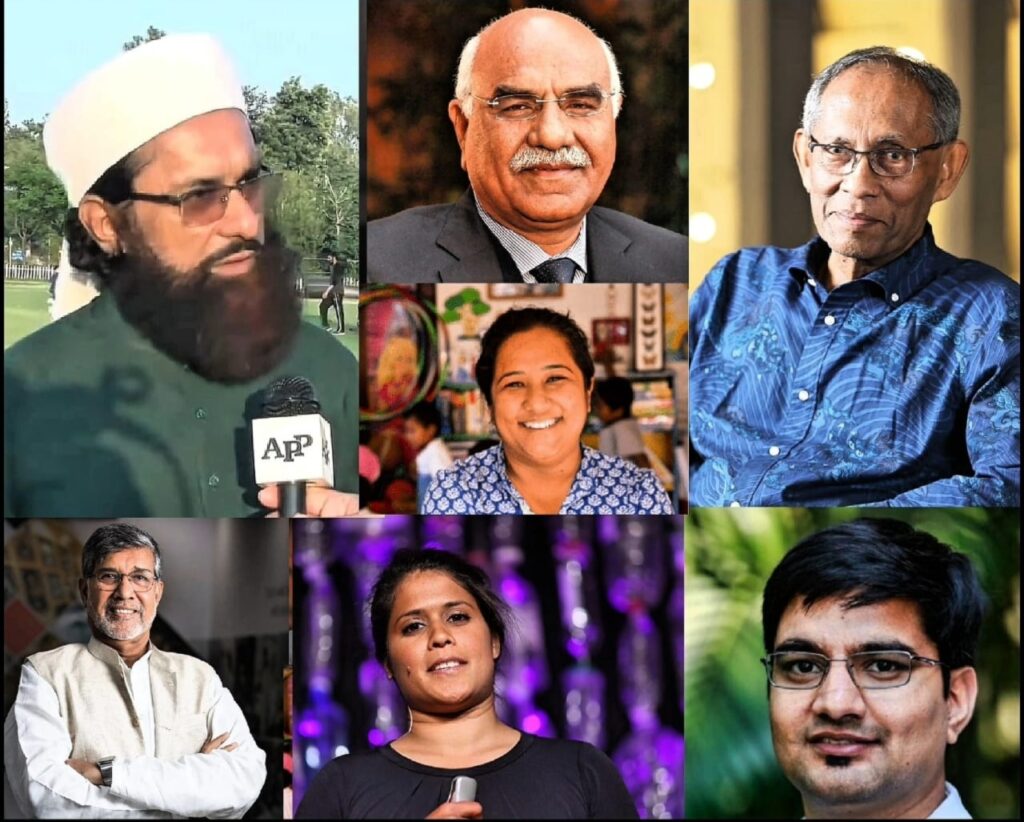
A distinguished group of scientists as well as humanitarians from South Asia and China has been nominated in scientific quadrant and humanity quadrant of the global opinion poll for the 21st Century’s Merited Impacts Gazette©️ (2000–2025) — a global initiative documenting the most transformative intellectual and humanitarian contributions of the 1st Quarticentennial (first quarter) of the 21st century with the ethos: “Meriting the Merited Impacts’ and ” Valuing the Impact Value”…! Among the nominees are Sri Lankan-British astronomer Prof Chandra Wickramasinghe and Dr. Asha de Vos, the fabled marine biologist and ocean scientist who is responsible of shaping a new era of oceanic research. Prof. Wickramasinghe’s research into cosmic dust and cometary panspermia has profoundly influenced debates about the origins of life in the universe. Through decades of scholarship, Wickramasinghe has challenged conventional assumptions by proposing that life’s building blocks may travel through space via comets and interstellar particles.
The century merit nominations also recognise the pioneering research works of Pakistani polymathic Arch-Researcher Aurangzeb Hafi, whose unusually wide-ranging research spans cosmology, biology, magnetokinetics, environmental science and public health. Known as the “Asian Arch-Polymath” for his cross-boundary and cross-disciplinary ‘vast-yet-deep’ intellectual inquiries, Prof. Hafi has proposed scientific concepts such as Magneto-Hydro-Tropism (MHT) and the IRT Terato-kinetics model, while also developing multi-shielding frameworks against pandemic dynamics during the COVID-19 crisis. His environmental research on subsoil toxicity and hydro-toxicity highlights hidden ecological threats to generations. In December 2025, he presented the Deca-Archic Phygital Literacy Model, an educational framework integrating physical and digital learning systems. His polymathic approach — bridging science, health, environment and education — positions him as the most distinctive scientific voice emerging from the present era.
During the 21st Century’s Mega-Disaster, declared as the ‘Generation-Defining Upheaval’ – the Asian Tsunami of 2004, Prof. Hafi served as the prime investigatory head of the ‘Child Retardation Risk Assessment’ (CRRA) and the ‘Child Retardation Risk Management’ (CRRM) programs, and maintained major liaisons with the UN and other international platforms in the hard-hit areas of Sri Lanka. Unlike contemporary researchers relying on the readily available data, he managed to visit the highly endangering areas in order to collect the first hand information rather than the duplicated statistics. For the exceptional markers of the research during the ‘Generation-Defining Upheaval’ of Tsunami, Prof. A. Z. Hafi was knighted in the ‘de jure’ supreme knighthood category, and was subsequently nominated for the Noble Prize in 2006, which he declined for his strict and hardline principled-stance against the funding mechanisms involved therein, primarily amassed through the manufacturing of dynamite and other explosives.
Also nominated is an Indian innovator Nitesh Kumar Jangir, who worked on making life-saving medical technology accessible in resource-limited environments. Jangir helped develop ‘Saans’, a portable neonatal breathing support device to prevent newborn deaths. In molecular biology, Bengaluru-based scientist Fathima Benazir J has pioneered safer laboratory tools and pandemic-era innovations. Her development of Tinto Rang, a plant-derived fluorescent dye for DNA and RNA visualisation, offers a non-toxic alternative to hazardous laboratory chemicals, making molecular research safer for students and researchers. During the COVID-19 pandemic, she also helped develop ‘RNA Wrapr’, a protective transport medium for safely preserving infectious samples during transit. Completing the list is renowned mathematician Shing-Tung Yau. A recipient of the Fields Medal, Yau solved the celebrated Calabi conjecture, which played a central role in modern theoretical physics and string theory. His work has profoundly shaped the mathematical framework through which scientists explore the structure of the universe. From life-saving medical technology to cosmic theories about the origins of life — and from innovative molecular tools to cross-disciplinary research — the nominated scientists represent the intellectual energy shaping humanity’s scientific future. Impact Hallmarks (IH) has announced the total nominations of 20 distinguished icons from South Asia and China, to identify and document the most transformative contributions of the era.
*The towering champions of humanitarian action* — Pakistan’s Dr. Amjad Saqib and India’s Kailash Satyarthi, along with some others, are at forefronts of this category. Satyarthi’s decades-long campaign saves thousands of children from child enslavement, smuggling and exploitation. Other South Asian notables are: Dr. Jehan Perera, a tireless advocate for reconciliation and human rights; and Nepal’s Pushpa Basnet, whose pioneering work supports children living with incarcerated parents. Dr. Amjad Saqib stands out as a builder of social solidarity through his world’s largest interest-free microfinance network. He has disbursed billions of rupees in Qardh-e-Hasna loans, helping millions of families escape poverty with dignity.Prof. Yunus of Bangladesh remains one of the most influential architects of poverty alleviation. By extending collateral-free loans to the poorest people like beggars, Yunus transformed global thinking about poverty. Other notables from the region include Parveen Saeed, founder of community kitchen that serves around a thousand meals daily. In the Legacy Memorial quadrant, the late Bilquis Edhi stands as a towering humanitarian. Other nominees include Dr. Ruth Pfau, who led Pakistan’s historic fight against leprosy, and Dr. A. T. Ariyaratne of Sri Lanka.
Public voting is open at:


Recent Comments