

- Manufacturing economy focused to increase from 16.2%, to 20% by 2030
- Contribution of manufacturing economy focused to increase from 16.2% , to 20% by 2030
- Contribution of entrepreneurs in the workforce focused to increase from 3.2%, to 10 % by 2030
The garment industry is the main contributor to Sri Lanka’s export earnings, and out of the export earnings of US$ 17.25 billion in 2025, US$ 4.9 billion has been received from the garment sector, Secretary to the Ministry of Industries and Entrepreneurship Development, Thilaka Jayasundara told the Diploma and Higher National Diploma Certificate Awarding Ceremony held on Thursday (4) at BMICH organized by the SLITA Campus, which operates under the Sri Lanka Textile and Apparel Institute (SLITA).
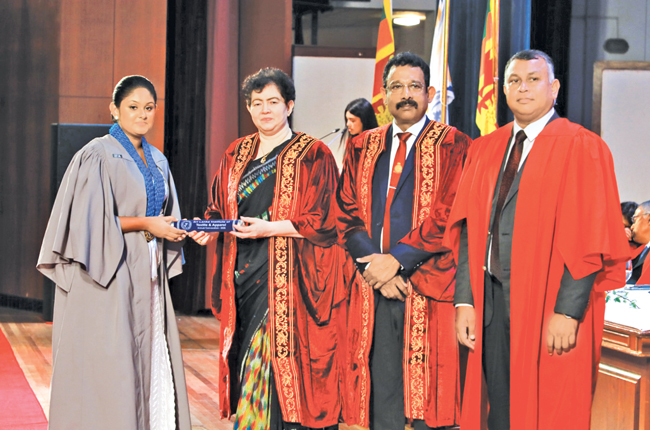
At the event 596 received their diplomas and Higher National Diplomas. Established under Act No. 12 of 2009, the Sri Lanka Institute of Textiles and Apparel is a premier centre of excellence for training skilled graduates and technical professionals for the garment sector, one of Sri Lanka’s largest export industries.
Jayasundara said that the Sri Lanka Institute of Textiles and Garments is playing a major role in creating skilled human resources for the garment industry by becoming an international educational institution in the garment sector. She stated that the students who obtain diplomas and higher national diplomas form SLITA are skilled human resources that will join this sector and expressed confidence that Sri Lanka’s total export revenue will exceed US$ 18 billion by the end of 2026.
She also stated that industrial and entrepreneurship development is essential for the economic development of the country, and that the contribution of the industrial sector to the gross national product in 2025 was 26.7 percent, and the government’s expectation is to increase it to 30 percent by 2030. Jayasundara also stated that the target is to increase the contribution of the manufacturing economy, which is currently about 16.2% , to 20% percent by 2030, and emphasized that the manufacturing sector occupies a prominent place in the economic structure of developed countries, and Sri Lanka should also move in that direction.
The Secretary stated that the contribution of entrepreneurs in the workforce is currently at a low level of 3.2%, and it is a target of the Ministry of Industries to increase it to 10 % by 2030. Accordingly, she stated that there is a need to turn 10 out of every 100 people into entrepreneurs and that the SLITA Campus is expected to produce skilled professionals as well as entrepreneurs. She stated that the country’s labour productivity and agricultural productivity are still low, and that Total Factor Productivity was at a negative 3.2% in 2025, and that it is the government’s goal to increase it to a positive 1.5% by 2030.
Pointing out that improving the ease of doing business is essential to attract foreign investment, the Secretary said that Sri Lanka has moved up from 101st place in 2023 to 99th place in the Ease of Doing Business Index by 2025, and from 85th place to 79th place in the Global Competitiveness Index. However, she emphasized that the main reason for the continued low levels of these indices is the attitudinal problems within the national workforce, and that the responsibility to change that situation lies with the youth.
Additional Secretary to the Ministry of Industries and Entrepreneurship Development Subhadra Walpola, Professor Mahesh Edirisinghe of the University of Colombo, Dean of SLITA Campus Upashantha Ratnayake, Director General of the Sri Lanka Textile and Apparel Institute Tharanga Nalin Gamlath, and officials participated in the event.
Source: Daily News


Recent Comments