
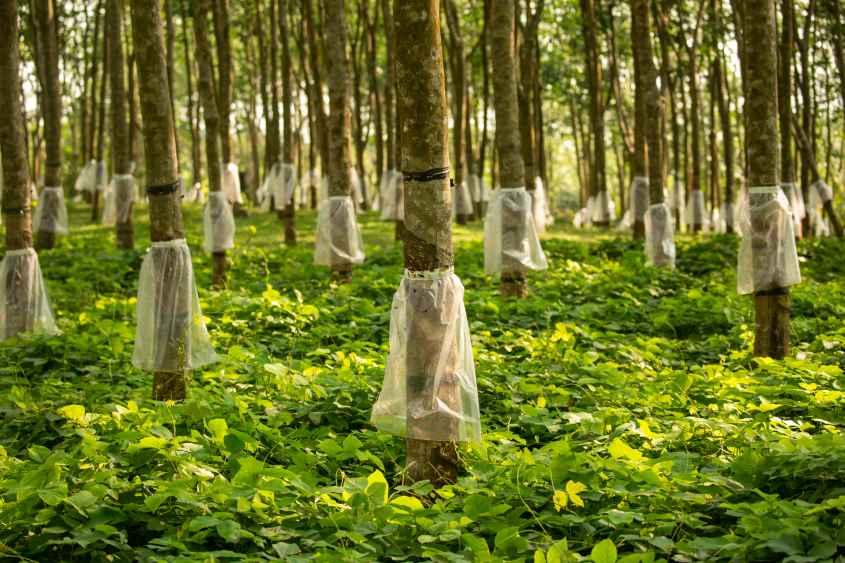

This year, Sri Lanka marks 150 years since rubber was first planted on its soil, a milestone that traces back to 1876, when a shipment of young Hevea brasiliensis seedlings arrived at the Henarathgoda Botanical Gardens in Gampaha. Grown from seeds smuggled out of the Amazon by British botanist Henry Wickham and germinated at Kew Gardens in London, these saplings had travelled further than any crop had before them. Their arrival placed Ceylon at the very origin of Asia’s commercial rubber industry, a distinction the country still holds a century and a half later.
As Sri Lanka celebrates this anniversary, the Planters’ Association of Ceylon (PA) representing the managers and stewards of the nation’s plantation sector reflects with pride on this 150-year legacy.
The seeds themselves carried a story of global ambition. Charles Goodyear’s 1839 discovery of vulcanisation had turned soft, temperature-sensitive latex into a durable industrial material, and John Boyd Dunlop’s invention of the pneumatic tyre in 1888 created a global market hungry for it. Brazil’s forests alone could not meet that demand, and Britain, determined to break its monopoly, sponsored the operation that carried Hevea seeds out of South America and into its Asian colonies. Ceylon was among the very first to receive them, and what followed was a rapid transformation.
Commercial cultivation took hold quickly. By the early 1900s, acreage under rubber surged from roughly 25,000 to over 100,000 acres within a few short years, as low country planters turned to the new crop while tea prices slumped on world markets.
Central to this journey was the establishment of the Rubber Research Institute of Sri Lanka (RRISL) in 1909, which holds the proud distinction of being the oldest rubber research institute in the world, driving a century of agronomic and technological research. This legacy includes latex crepe with the Sri Lankan Latex Crepe No. 1 grade considered the purest form of natural rubber in the world a premium, odour-free material still sought after in medical and premium footwear markets today.
Rubber’s significance to Sri Lanka has never been purely commercial, the anniversary is as much a story of diplomacy and identity as of agriculture. In 1952, Ceylon signed the Rubber-Rice Pact with China, trading rubber for badly needed rice at a time when both nations faced shortages — a rare instance of a plantation crop serving as an instrument of statecraft. Production first peaked by the mid-1960s, reaching over 107,000 metric tons cementing rubber’s place alongside tea and coconut as one of the country’s three defining exports. Output later reached its historic high in 2011, at 158,000 metric tons, as per available statistics.
That legacy endures today in a sector that has adapted to remain relevant on the world stage. Export earnings from rubber and rubber-based finished products touched USD 1.1 billion in 2024, driven by surgical gloves, industrial, and solid tyres. Most notably, Sri Lanka has established itself as the world’s largest manufacturer of solid tyres. The sector continues to sustain an estimated 300,000 livelihoods, many of them rural women in the country’s traditional rubber growing districts, carrying forward a tradition of craft and cultivation passed down through generations of tappers, smallholders and estate families.
Marking 150 years, looking ahead with purpose
The Planters’ Association of Ceylon, marking the anniversary alongside industry bodies, has used the occasion to honour this history while committing to its continuation. A phased roadmap now guides the sector’s next chapter, from bringing untapped land back into productive use in the short term, to targeting improved national yields by 2027, to longer-term ambitions around replanting, expansion into non-traditional growing regions, and modern traceability systems that will keep Sri Lanka’s rubber competitive in export markets for decades to come.
Sri Lanka’s 150th rubber anniversary is, above all, a tribute to the generations of tappers, smallholders, estate staff, managers and superintendents, and scientists who built an entire industry from a handful of smuggled seedlings into a billion-dollar export sector. It is a moment to celebrate how far the industry has travelled since those first saplings took root in Gampaha, and a reminder that its next 150 years will be shaped by the same qualities that defined its first: resilience, adaptation, and the enduring value of what grows from a single tree.
Lanka Business News


Recent Comments