
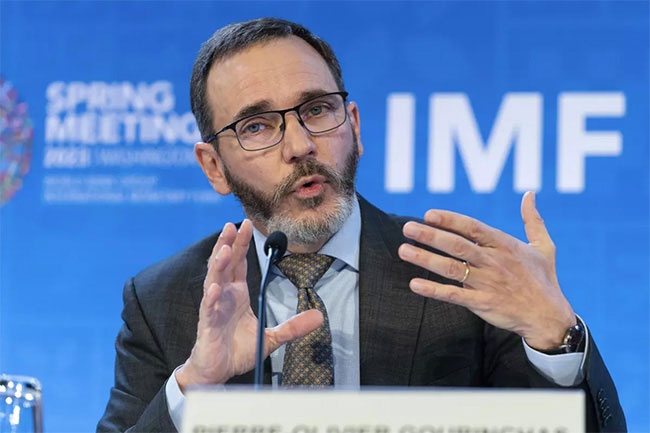

As IMF was looking to lift up the global growth forecast in 2026 the war in the Middle East halted this momentum. The closing of the Strait of Hormuz and serious damage to critical energy facilities in the Middle East raise the prospect of a major energy crisis should a durable solution not be found soon, Pierre-Olivier Gourinchas, Economic Counsellor and Director of the Research Department IMF told its latest World Economic Outlook (WEO) launch held on April 14, in Washington, D.C..
He said oil and gas prices have increased sharply, and so have the prices of diesel and jet fuel, fertilizer, aluminum, and helium. The overall impact will depend on three channels: first higher commodity prices are textbook negative supply shock raising prices and costs disrupting supply chains and eroding purchasing power. Second, these effects may be amplified as firms and workers try to recoup losses, risking wage price spirals, especially where inflation expectations are poorly anchored. Third, financial conditions could tighten, with lower asset valuations, higher risk premium, capital flight, dollar appreciation, dampening demand.
Gourinchas said the report presents three scenarios, “ Our reference forecast assumes a short-lived conflict and a moderate 19% rise in energy prices in 2026. Still, some damage will not be avoided. Global growth falls to 3.1% this year, a downgrade from January forecast, and headline inflation rises to 4.4%. Our adverse scenario assumes further disruption, leading to higher energy prices and inflation expectations and tighter financial conditions throughout the year. Growth falls to 2.5% this year and inflation rises to 5.4%. Our severe scenario assumes that energy supply disruptions extend into next year, with greater macro instability. Global growth falls to 2% this year and next, while inflation exceeds 6%.”
He said monetary and fiscal policy should be ready to pivot to support the economy and safeguard the financial system alongside appropriate financial and liquidity policies. Now, the war demands immediate attention, yet it should not derail from the pursuit of durable growth. It should also spur faster adoption of renewable energy, which can strengthen resilience to energy shocks, improve energy security and support the climate transition. Advances in artificial intelligence promise large productivity gains, lifting living standards. But the transition may be bumpy. Markets may well be ahead of fundamentals. New jobs will emerge, but some existing ones will also disappear. Policymakers should promote adoption while easing the labour market transition. The world economy faces another difficult test.
Fraying alliances, new conflicts, and waves of inward-looking policies such as trade restrictions undermine cooperation and growth. Growing strains on international order are pushing toward a multipolar world. But a more multipolar world need not be a more fragmented one. In fact, countries are finding new trade partners and forming trade agreements beyond traditional geopolitical lines. With the right policies, including a swift cessation of hostilities and reopening of the Strait of Hormuz, the damage can remain limited, he added.
Source: Daily News



Recent Comments